Bill paid to clinic
Amount
$1,200
Reason
All four hypothetical invoice categories

Follow the cat’s actual charges through eligibility and payment, and verify how the vet and insurer handle the paperwork.
Use these checkpoints to frame the literal question before reading the full guide.
Cat vet insurance can help pay eligible veterinary expenses under a pet policy. It does not make every vet bill payable or automatically mean the clinic accepts direct insurer payment. Read the eligible-expense clause, payment formula and provider requirements, then plan for the amount you may need at the visit.
The sections below show how to verify the answer and what can change it.
The vet’s invoice and the insurer’s eligible-expense total are not necessarily the same. Ask for a bill separating the examination, tests, treatment, medications and any routine or administrative items. Then identify the contract provision for each line. A diagnosis that qualifies does not automatically settle every associated charge.
For provider choice, look for the definition of veterinarian, permitted treatment territory and any network or referral rule. Washington’s regulator specifically tells shoppers to check veterinarian-network requirements. That does not mean your chosen cat policy has a network, or that a clinic’s location proves it can receive direct payment. Verify the actual contract instead.
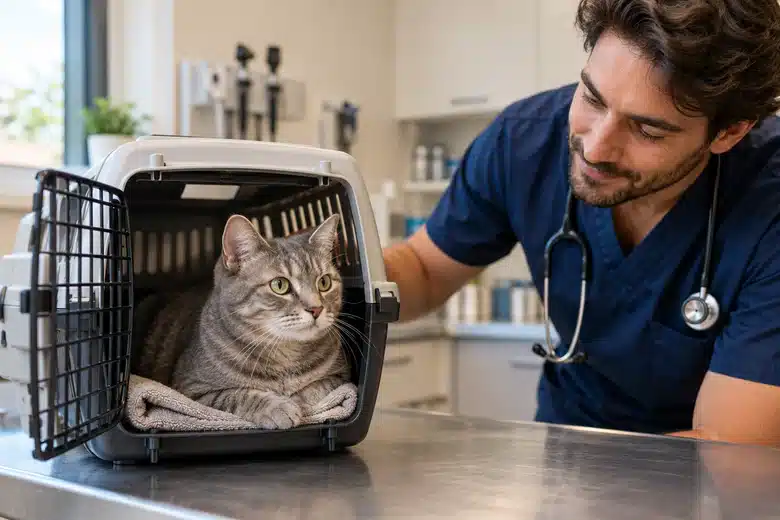
This is an entirely hypothetical bill and contract, not a local vet price, insurer quote or coverage promise. Assume a $1,200 bill: $100 examination, $200 tests, $750 treatment and $150 take-home medication. For this example, the contract excludes the exam, admits the other $1,100, applies 80% reimbursement first and then subtracts a $200 remaining annual deductible. The remaining payout limit is more than the result.
| Stage | Amount | Reason |
|---|---|---|
| Bill paid to clinic | $1,200 | All four hypothetical invoice categories |
| Excluded exam line | − $100 | Assumed exclusion for this exercise |
| Eligible expense | $1,100 | Tests, treatment and medication admitted by assumption |
| Apply 80% | $880 | Hypothetical contract’s chosen calculation order |
| Subtract remaining deductible | − $200 | Already remaining, not the full original deductible again |
| Insurance payment | $680 | Assuming all other claim requirements are met |
| Final owner share | $520 | $1,200 bill minus $680 payment |
If the policy instead deducts $200 before applying 80%, the payment would be ($1,100 − $200) × 0.80 = $720. That $40 difference is why the sequence belongs in your worksheet. Neither formula should be silently substituted for the other. The official Pets Best calculation guidance illustrates that underwriting company and policy effective date are relevant when selecting its formula.
Keep policy terms, deductible, reimbursement and limits beside the quote so the comparison stays consistent.
Check the policy’s provider definition, territory and any applicable network restriction. An eligible provider does not guarantee an eligible condition.
Ask what deposit or full payment is required before treatment and discharge. Do not assume direct payment merely because the practice has handled claims before.
Confirm whether you upload invoices, the clinic sends records, or both. Keep the record-transfer contact and claim reference.
As a limited example, the reviewed Alabama Pets Best specimen requires treatment by a veterinarian or directly supervised staff and allows the insurer to request complete medical records. It excludes certain administrative charges, including records-processing costs. These provisions illustrate questions to ask; they are not a statement of your cat’s benefits in another state.
A clinical referral and an insurance approval are different records. Ask the insurer whether the proposed specialist treatment needs a referral, prior authorization or other documentation under your actual policy. Ask the receiving clinic which records and diagnostic images should be transferred. The absence of a prominently advertised network is not evidence that no other provider or claim conditions apply.
In the hypothetical example, the owner’s final share is $520, but a reimbursement arrangement could require the full $1,200 at the visit. A direct-payment option still needs confirmation from the parties involved.
The policy determines provider requirements. Check them rather than assuming either a mandatory network or unrestricted choice.
No. Records support the assessment; the contract and treatment facts still control eligibility.
These links provide independent government, academic or reference background. Actual policy wording controls insurance eligibility, benefits and claims.
Keep the policy terms beside the price, then continue to rates when the comparison is clear.